19th January 2026
Minister for Children, Disability and Equality, Norma Foley today welcomed the
significant increase in the number of children benefitting from the National Childcare
Scheme.
The scheme provides subsidies that substantially reduce the cost of early learning and
childcare for tens of thousands of families across the country.
New data shows that a total of around 245,000 children benefitted from the scheme in
2025 – a 12% increase on around 218,000 children who benefited from the scheme
in 2024.
There were significant increases in the number of children benefitting from NCS
subsidies in Clare (18% increase), Offaly (18% increase) and Roscommon (16%
increase). Meanwhile, the number of subsidised children has increased by 9% in Dublin
city and an average of 13% in other areas of County Dublin.
The increase in uptake reflects the continued Government investment in the early
learning and childcare sector, including a 53% increase in the minimum hourly National
Childcare Scheme subsidy from September 2024.
Minister Foley said:
“This increase in the number of children benefitting from the National Childcare
Scheme is a positive development. The National Childcare Scheme has undergone a
significant number of enhancements in recent years and we will continue to build on
that progress. New, lower maximum fee changes for families paying the highest prices
and higher subsidies for lower income families are on the way in September. I am
committed to ensuring families across the country have access to more affordable
early learning and childcare.”
The recently published Shaping the Future: The Early Years Action Plan contains details
of changes to the income-assessed National Childcare Scheme subsidies which will
improve affordability for up to 47,000 children from low-income families.
These changes, which will be introduced in September 2026, will increase the lower
income threshold from €26,000 to €34,000 and the upper threshold from €60,000 to
€68,000. The multiple child discount will also be increased, which reduces parents’
reckonable income for the Income Assessed subsidy.
There will also be reductions in the highest fees charged to parents across the country
from September 2026, with the lowering of the maximum fees that Core Funding
Partner Services can charge. These new, lower maximum fee levels will be announced
in the coming months when full financial returns from providers have been analysed.
ENDS
Note for Editors
The data referred to in this press release is provisional and represents the number of
unique children availing of the National Childcare Scheme (NCS). These figures are
provisional and may increase over the coming weeks. A county level breakdown of the
number of children benefitting from National Childcare Scheme subsidies is as follows:
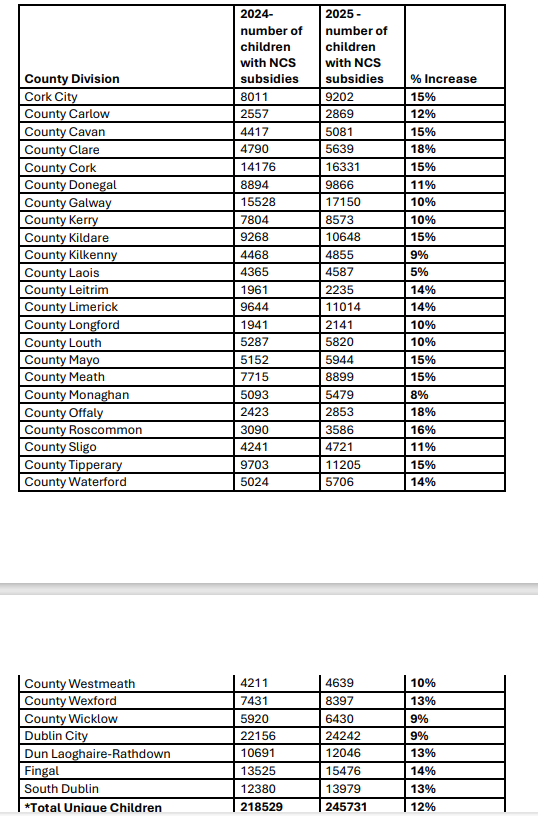
Please note: Final ‘total unique children’ may differ from the total sum of county level
data. This is because a child may have multiple claims within a given year i.e. claims
with more than one service provider or across two counties etc. However, for the
purposes of the final total, such children are only counted once.
The National Childcare Scheme
The National Childcare Scheme provides financial support to help families with their
early learning and childcare costs. The Scheme, which was introduced in November
2019, has been designed on the principle of progressive universalism ensuring that
families on the lowest incomes receive the greatest level of support.
There are two types of subsidies available to families:
- Universal subsidies are available to all families with children between 24 weeks
and 15 years of age. This subsidy is not means tested and provides €2.14 per
hour for a maximum of 45 weekly hours. - Income Assessed Subsidies are available to families with children aged between
24 weeks and 15 years. This subsidy is means tested and will be calculated
based on the applicant’s individual circumstances. The rate will vary depending
on the level of family income, the child’s age and educational stage, and the
number of children in a family.
